
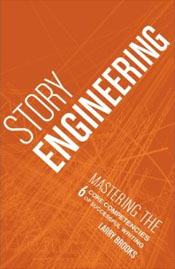
 You all remember Larry Brooks of the Top 10 Blogs for Writers. He wrote a guest post for me, Self-Editing at the Story Level, last March. That same week, he hosted me on his site, Storyfix, with the guest post, The Bootstrapping Writer—The Secret at the Core of Competency. Larry is the critically-acclaimed author of five psychological thrillers, one of them a USA Today bestseller, and a writing instructor through the Oregon Writers Colony. Writers Digest Books recently published his nonfiction Story Engineering: Mastering the Six Core Competencies of Successful Writing.
Now he’s re-releasing three of his thrillers under his own imprint, throwing a high, hard one for the ebook revolution.
Welcome back, Larry! Let’s ask the obvious question first. You’re re-releasing three of your previously published novels, is that right? Can you tell us about that? What made you decide to do it now?
I actually have four previously released novels, in addition to my latest, Whisper of the Seventh Thunder, (total of five), which is still active with the publisher. (The rights to the first four were given back to me when Penguin-Putnam and I parted ways. . .which is another long story.)
I wanted to re-release (is that even a word?) all four of those, but I can’t find the digitial files for #3, so until I do it remains the Omitted One. Unless I scan it in from the published paperback or retype it, it won’t happen. Bummer.
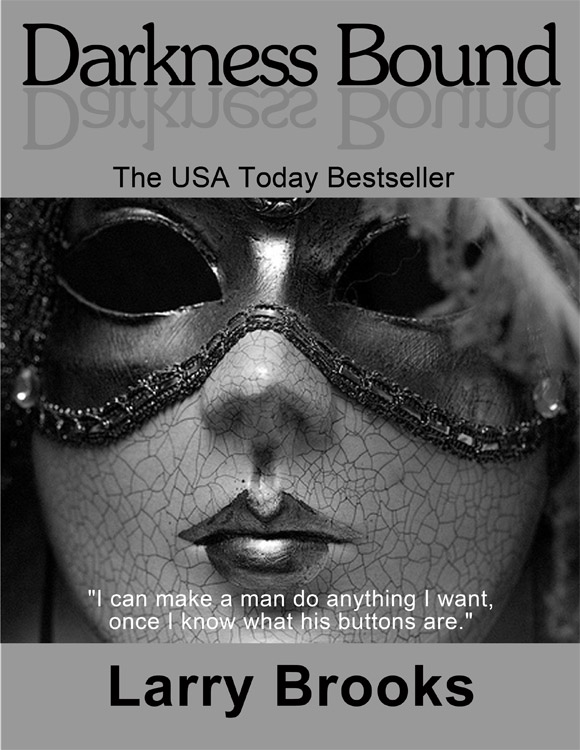
I’m republishing The Seminar (Kindle, Smashwords, Nook), Darkness Bound (Kindle, Smashwords, Nook) and Bait and Switch (Kindle, Smashwords, Nook).
 Why republish anything? Because my website is a pretty good platform for my author brand, and with the uncharted potential of this new venue, digital ebooks, I want to be in the game, in addition to watching it and writing “about” it. I’m thinking a “republish” of a successful novel is a little different than a new “self-published” book that was never published (sorry if that smacks even a little of elitism), which is a side-niche that hasn’t really taken hold yet, but I think it will. Want to be there when it happens.
The backbone of what you teach about writing is your theory of the six core competencies. Can you summarize each in one word? Characterize each as a character in canonical literature?
I actually don’t think I can summarize each core concept in one word. One reasonable sentence, perhaps, but each CC (concept, character, theme, structure, scene execution and writing voice) is too layered, complex and critical to attempt to simplify down to one word.
As far as an exemplary character for each CC goes. . .well, character is just one of the core competencies, the other five being either story-specific or execution-specific. So I can’t think of a single iconic character from literature that represents them all. For example, Holden Caulfield (Catcher in the Rye) is one of the best characters ever written, but he’s not a concept or a theme, he’s not structural, he’s not a scene and he’s even not the voice (though that’s the one CC I’d assign to him), which belongs to the author. Characters are the window into which we get to see concept, theme, structure and execution at work. Nothing more, nothing less.
How about this—give us an image of a lifeboat with those six characters in it when the most important one falls out.
If they were in a boat, they—as passengers—would be of equal importance. When any one goes overboard, the whole boat sinks. You ask a great question here, even though it appears I’m dodging the answer, because it makes my point: they are all equally vital and therefore necessary. Screw one up and the story will be seriously compromised. We need to get all six right. Successful stories always—no exceptions—do.
How did you develop your theory of the six core competencies? Was it a long and painful process throughout all your career moves, or did you go out flying a kite with a key in a thunderstorm one day and get struck by lightning?
Some of the backstory of this model has to do with me seeking a simplified way of putting the necessary attributes and skills required of a great story into separate buckets (so I could more easily wrap my head around it all), yet realizing that at some point those buckets must be poured out and mixed in a way in which the whole exceeds the sum of the parts. That’s how and why a story with each of six core competencies being simply “good” (versus “great”) can combine to deliver a “great” story. In fact, that’s usually what happens when “great” is the result.
So it was just my left brain trying to make sense out of a cloud of vaporous right-brained stuff that we writers have to handle. And which are challenging enough without bringing a left-brained sensibility to them. There are, of course, dozens of attributes and skills involved in writing a great story, but I’ve discovered that they almost without exception align under one of these six major categories. Have yet to hear of one that doesn’t.
 You’ve had quite a multifaceted career leading you to this place and time, so let me throw some questions at you about that. What do you know about writing that you’ve learned from marketing?
From marketing I learned that to publish you need to write “for” the audience (give them what they want and expect), instead of simply sharing what you want to write for yourself. Nothing wrong with the latter, but it greatly diminishes your chances of publication. There’s only a very narrow market for books that don’t fall cleanly into a genre.
Baseball?
I’ve learned that he who throws hardest is not necessarily the best pitcher. It’s about control and command of several pitches, thrown on any count, with consistency, winning the mental game, being fit and ready, and being courageous as well as fine-tuned. It’s about craft over and above talent, and that’s true in writing, as well.
You know that Hemingway quote, don’t you? “When you can’t throw a high, hard one, throw your heart instead”? I love that quote.
What about stock brokering?
I learned very little about anything in life from that, other than it is an over-rated way to make a living. Then again, stockbrokers make great characters because there are so many of them out there that are kinda messed up. Working all day at a job that doesn’t mean anything to the Big Picture of life will do that to you.
Personnel management?
I can’t get that Clint Eastwood line out of my head, when he was about to be demoted to Personnel: “Personnel? Personnel’s for assholes.”
[Laughing] Script-writing?
I learned almost everything from this corner of the writing world. The “how to” oeuvre in script-writing vastly exceeds that of novel-writing, both in terms of quantity and quality. Mostly, this is where I discovered what story structure looks like. . .it’s second nature for screenwriters and too often a foreign concept for novelists. And yet it totally defines the effectiveness of a story in either format.
Being creative director of a marketing & training company?
There wasn’t a day on that job that I didn’t think about writing fiction and about the craft of fiction, rather than the next wonderful printer for which I had to write a video and a brochure or website. You can only squeeze out so much blood for clients that routinely kill creativity before it feels like a total sellout. What I do now isn’t making me rich, but it’s making me happy, and it’s connecting me to real people in a very rewarding way. Hopefully for both sides. And it has an exciting upside that is still to be determined.
Agency-model pricing, ebook technology, rock-star publishing mentality, self-publishing—what do you see as the biggest challenge to the publishing industry today? How can the average aspiring writer realize their dreams in this context?
 Writers need to realize the one thing that hasn’t changed: the need for a compelling, well-executed story. Access to the marketplace through ebook venues like Kindle and Nook doesn’t change the fact that great stories will surface over mediocrity, even when mediocrity is being pimped by authors who are killer online strategists via social media (which is currently the only way to really promote your own work).
Thus we are faced with the real problem. Traditional publishing did two things well: they screwed up frequently by passing on some very good books and quality writers, and they vetted what was published in a way that ensured at least a certain level of quality out there.
That’s all gone. We’re on our own, and somehow there will be a way for great writing to surface among all the great marketing. It remains to be seen how this will look, but in the meantime it’s still about craft, not how good you are at Twitter and Facebook. I suck at the latter (I’m trying, though), and that may hurt me in the short run. But I’m confident in my work and press onward in the hope that this vetting will come soon. And I’ll be back on the shelves under a Big Six imprint soon.
I know you’re teaching a two-day workshop on Story Engineering at the Oregon Writers Colony in Portland on October 29 and 30. How did you get involved with the Oregon Writers Colony, and what’s special about it?
I was born and raised there, and they were my first writing community. I began teaching for them by virtue of having optioned some screenplays, and it went from there. It was through those teaching opportunities that I began to formulate the storytelling models that I espouse today and that I applied toward my own published novels.
The OWC is a great organization, and I hope many will take this opportunity to attend. It’s going to be intense.
Can you give us some insight into your own struggles with the craft of writing? What sucks worst for you? Why do you keep writing in spite of that?
Wow. A truly loaded question.
Because of my take on story architecture, my struggle isn’t as much with the writing as it is with finding the time for it. My website and my freelance work (I ghostwrite books for folks, as well as the occasional soul-selling corporate job) keeps me away from my current WIPs. (I have several in the hopper.)
Also, I struggle with people who accuse me of arrogance instead of the intended passion with which I preach the gospel of story architecture (the melding of all six core competencies, with story design and structure at the core). They confuse what I’m saying about story infrastructure as a commentary on process, which (while I don’t deny advocacy for story planning) is both necessary and available for pantsers (organic writers) and story planners alike. I want everybody to get this stuff. . .because every writer needs to get it. Why? Because every successful story—no matter how it got there—demonstrates it. This really isn’t a theory as much as it is a way to describe the writer’s requisite writers toolbox, which in this case comes with an instruction manual for each tool and requires them all to be involved.
 Your “long story” about parting ways with Penguin-Putnam sounds like an insider story about the contemporary publishing industry that aspiring writers really need to hear. Can you tell us that story?
With all this self-publishing talk, what gets lost in the conversation is the experience of actually being published traditionally. Like, with a Big Six publisher or a major niche label (such as Writers Digest Books publishing my new writing book). Fact is. . .it’s a gas. Totally living the dream. Even if there’s not big money involved, which there rarely is, there’s no substitute for going into whatever bookstore you are near and seeing your work there. When it appears (for a while) front and center in the window or on the top shelf, that’s nothing short of a lifelong memory. Yeah, I took pictures.
That said, there were frustrations and compromises, too. After you’ve written your manuscript, it’s completely somebody else’s baby, and usually you aren’t given a vote by your publisher on what happens to it.
Then when I came across a bookstore that wasn’t carrying one of my books, I was angry and disappointed. As if the dream was ending (mostly, though, it was distribution mix-ups). And then when the book begins to fade from the top shelf (which happens quickly with paperbacks, unless you are an established A-list author name, which I certainly wasn’t, even after four books in five years), that hurts, too. Then there is the struggle to reposition the book every time you go into the bookstore, replacing it on that top shelf where it belongs before the shift manager asks to see your ID. (That happened to me. . .twice.)
The dream is almost always temporary. And that was the hardest part.
Concurrent with my first book, I recall going to a publisher-thrown party at a major writing conference (Bouchercon), where there were nineteen of their authors in attendance. Two or three were huge names like Jan Burke, two or three were less known but familiar, and the rest of us were fairly new. I kept track of them. Within six years only two of those authors were still publishing with that Big Six imprint. Two or three others had gone to smaller presses, and one had a self-published book out. The rest, including me and including a Barry Award winner. . .we were huddled under the bus where we had been cast.
The question is: why? There are many possible answers. Mine was—and this is the most common—the sales trend. I received a pretty decent advance for my third and fourth books, and they weren’t “selling through” (making the advance back). This is a paradox, of course, because the slower the sales, the less promotion budget they throw at it, which begets fewer sales as time marches on. Interestingly, as my four novels trotted out over those five years, each received a better level of critical praise than the one before.
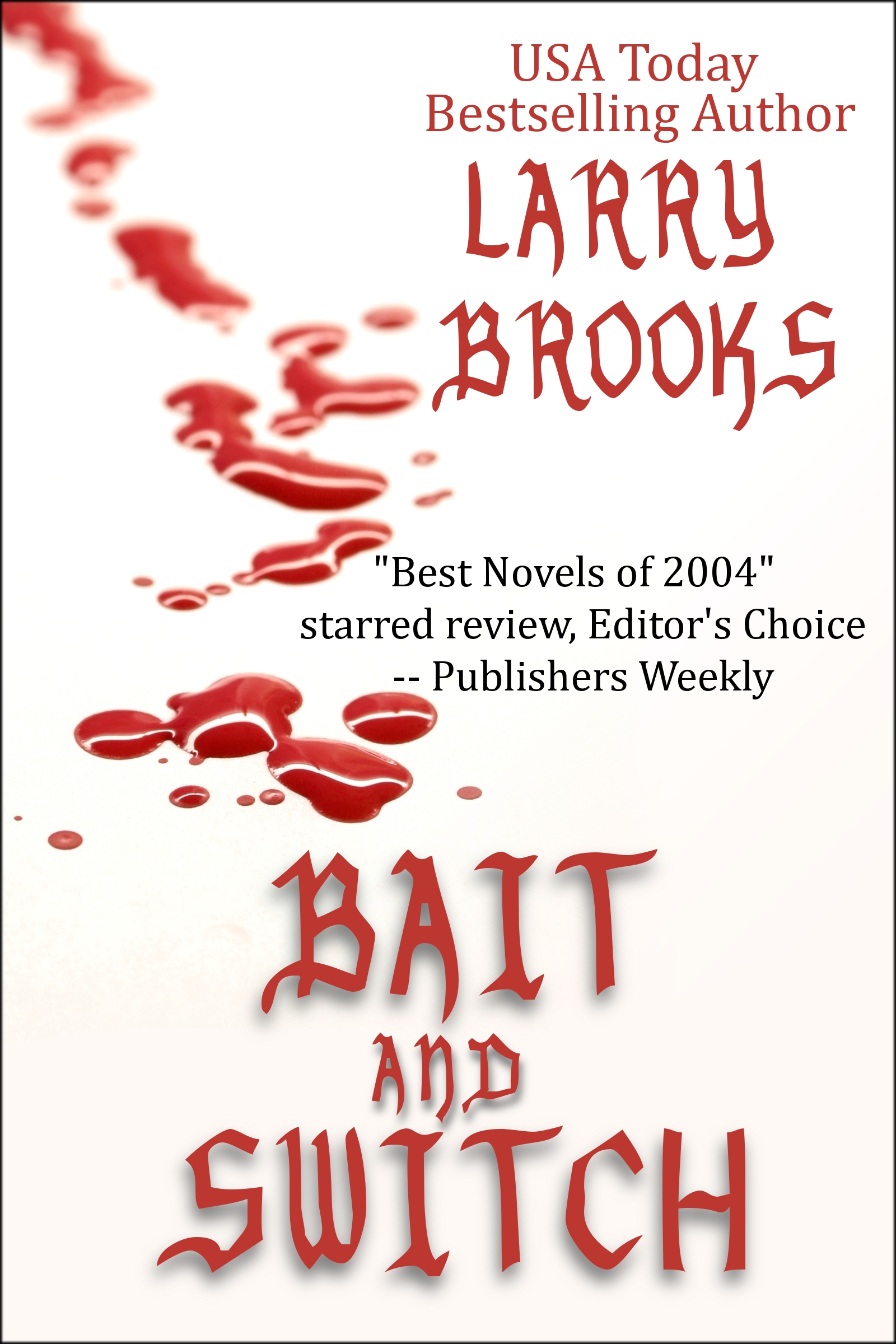 My last novel in that era, Bait and Switch, was a Publishers Weekly “Best Books of 2004” selection and sold about one-eighth the number of copies of my first book, which was a USA Today bestseller. . .go figure. Fact is, my publisher dumped me after the third book, before my fourth book, Bait and Switch, came out to those glowing reviews, and therefore didn’t throw ten cents at promoting it and didn’t even notice the critical praise. Not to mention, the people I knew there left for other firms, and the new crew considered me old inventory.
One has to adjust, at that point. I pouted for two years. Then wrote what I think is my best novel, Whisper of the Seventh Thunder, sold it to a small but visionary publisher (this, after my agent jumped ship, too), and launched Storyfix.com as, partially, a strategy to re-brand and get back into the mainstream. From that came Story Engineering, and suddenly I’m back repositioning my book on a different shelf.
What I’ve learned from all this is that it’s really about the storytelling and the community rather than the selling. It really is. There isn’t that much money in it, even when you’re “on the top shelf,” so the journey proves itself to be the thing. Doesn’t mean we shouldn’t aim high, just that we should keep aiming and firing off the best work we can in any case, in the knowledge that the target is illusive, shape-shifting and slippery as a stealth fighter.
We have control over only one thing: the manuscripts we submit.
 Larry Brooks is the creator of Storyfix.com and the bestselling author of five critically-praised novels with his newest book, Story Engineering: Mastering the Six Core Competencies of Successful Writing, published this year by Writers Digest Books. He can be found on Twitter.

“The freshest and
most relevant advice
you’ll find.”
—Helen Gallagher,
Seattle Post-Intelligencer
The Art & Craft of Fiction
The Art & Craft of Story
Victoria’s Advice Column: Eliminating the Internal Critic—For Young Writers
Wow! Thanks for sharing your story. If writers are paying attention to the stories on blogs out on the internet, there’s no way they can enter traditional publishing without realizing that this is a hard business. Wishing Larry the best of success!
Hi Victoria! Hi Larry! I just wanted to say that Larry’s Story Engineering has become my writing bible. He revolutionized the way I approach each new book. I certainly don’t feel creatively stifled because he doesn’t tell me what to write about, his process merely helps me establish a blueprint. Any good builder works off a blueprint. A home wouldn’t be structurally sound without one. That doesn’t mean the homeowners can’t pick their own decorations and furniture. Thank you, Larry, for all you’ve done for writers, and I wish you continued success! 🙂 Misty
I second Misty’s comments. Larry’s beat sheets should be required reading for all creative writing majors. They’ve made all the difference in my writing–and in my confidence to write.
Hi Victoria,
thanks for featuring Larry on your site. I love your ‘author pose’ (below). Are you holding a dog, cat or bunny?
It’s difficult to read the truths about the state of the publishing industry or it’s current transitions. It seems that a can of worms is spilling out all over the place. The insights are mind-numbing.
I have to wonder if the calling to write is a journey to new heights of existence, or an exercise in self-flagellation – it’s like the journey ends in hitting a wall even if you succeed in publication. Publishers seem so cruel, inconsistent and unreliable – just like the film or fashion industry dumps their starlets and models simply for turning 30.
Having not yet gotten Larry’s book on story structure (re: the CC’s mentioned), or The Seventh Thunder, for fun- I can say that his blog/website are highly regarded by me for all that he’s explained and exposed – no one word expresses my appreciation of that generosity. (I hope to show that through a purchase of his books.)
Thanks, Victoria, for sharing the inside/truth about different aspects of what it is to pursue this dream. A writer almost doesn’t have a choice but to enter in, even knowing these things, but it should help soften the blows knowing it’s the ‘norm’. It should encourage courage and fortitude in your followers – “If Larry can do it, so can I”.
Or die trying.
It’s a cat. The Grey Peril in my banner photo.
I went to a ton of classes, read a shelf full of books, wrote 3 manuscripts to ‘the end’, but it wasn’t until I attended a Larry Brooks class that the big light went on in my head. Now when I think about a story, I see it not as a confusing blob of words, but as a story that rises and falls in certain and pleasing waves that magically (and mysteriously) satisfy the patterns that humans have been wired to respond to.
Instead of restricting me, my awareness of these patterns (which Larry points out as inherent in good story telling) frees me to be more creative.
Fantastic interview with a man who certainly knows what he’s talking about. I highly recommend his workshops.
Now that’s an interview, Victoria. I have to love Larry’s honesty and directness, as much as his approach to story structure. I have been following his blog posts and purchased two of his eBooks about a year ago. I had no doubt about the quality of his fiction writing, only the genre he writes isn’t one I tend to read and being from northern England, I prefer gritty story-lines about imperfect people slumming it… BUT when The Seminar became available on Kindle for a very reasonable price, I figured this was a story I could sink my teeth into, overlooking the “American nuances” (sorry) and see how Larry himself executes what he so passionately teaches. I was hooked. Suddenly it was blatantly obvious, that here is a man who has earned the right to speak boldly. The complexity of plot, character dev., setting, emotion: pure skill. Put it this way… I had only ever shared one book with my husband (The Axe by Donald Westlake). This was the second.
Hey Larry! Great interview! You know I’m a fan! Smack dab in the middle of Bait and Switch!
It is daunting to aspiring writers, especially when you hear the stories about what it took for many famous authors to make it….The Help was turned down 60 times and J. K. Rowling practically had to beg a company to be her agent and then they practically had to beg someone to read her first book in her now world famous series.
Keep up the great work!
Great informative interview. I’m signed up for the Oregon workshop and looking forward to it. Story Engineering really spoke to me.
I’ve been helping a client write a short story. He is a young adult who has autism, and has great difficulty getting his ideas down on paper. I was excited to learn about Larry and Storyfix from my daughter, Christine Myers, of LadyMyersWordsmithing. Just the little reading I’ve done so for in Story Engineering is helping me to help my client corral his thoughts. Thanks!
Terrific interview – Larry, thanks for sharing this information. I’m in the midst of reading “Story Engineering” and it’s mind-blowing. I tend to be a left-brained kind of person and have struggled while learning to write because much of the instruction is so unstructured. This book has helped me apply a bit of structure to a very unstructured problem while still allowing for all the creativity necessary in writing. Thanks for the interview and thanks for the book – I plan to post a review on my site once I’ve finished 🙂
I like Larry Books class, now when I think about a story, I see it not as a confusing blob of words, but as a story that rises and falls in certain and pleasing waves that magically (and mysteriously) satisfy the patterns that humans have been wired to respond to. Instead of restricting me, my awareness of these patterns (which Larry points out as inherent in good story telling) frees me to be more creative.