
So, last month was all about writers conferences, and if you were busy all month actually attending those conferences you can catch up with us here, and here, and here, and especially here (a story of hope!).
 Then last Friday I confessed what happened after that last writers conference, when I got my first agent and my first book published and my whole life turned into one, long, glamorous stroll up the glorious, golden rainbow of publication.
Except for my publishing house whizzing by on a souped-up roadhog so I wound up hospitalized with a bad case of broken dreams.
While I was at the hospital I also had a baby (well, nine months later), but that wasn’t the publisher’s fault. That was mine and my husband’s.
And—for the record—that particular move turned out to be brilliant.
But actually what I did last week—while I was telling you all that story—was go offline and hang out in the summer sunshine and enjoy the hilarious, charming, and charismatic fruits of that brilliant trip to the hospital fifteen years ago: my son.
Plus I worked on a novel that used to be a ghost story (as described in The Art & Craft of Story: 2nd Practitioner’s Manual) but is now a god-knows-what involving all my favorite elements of grand, gothic literature only as if it all happened at my house.
Sort of.
1. Jadestone Hatchet
And while I was flexing my arms over my head yesterday reveling in the pure, unadulterated joy of fiction—of being a writer of fiction—I finally figured out how to keep my papers organized.
For those of you who write fiction, this will be of extraordinary importance.
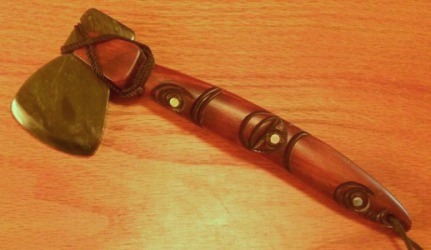 It involves an object I once wanted with all my heart and soul when I was traveling in New Zealand as a young, footloose, rather scatter-brained writer (a poem about which trip can be found in the Volume 34, Number 1 issue of The Northwest Review), but which at the time I couldn’t possibly afford.
So fifteen years later when some friends traveled to New Zealand they brought me home a smaller facsimile.
No, I didn’t use the little jadestone hatchet to chop up all my notes into tiny subatomic particles so I wouldn’t have to organize them.
Cynics.
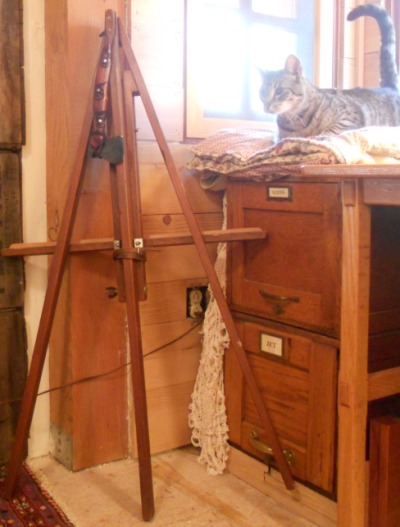
2. Artist’s Easel
Instead, I took the artist’s easel my father made for me for my fifteenth birthday—back when we both thought there was a possibility I would become a painter rather than a writer—which I keep propped in the corner next to my desk to remind myself I could so easily have gone to art school and wound up qualified to teach something for which I might actually have to leave my office. . .
And I looked at the mountain of notes on my current manuscript that I had intended to spend the day sorting so I could clear my desktop for the activity of—um—writing. . .
And a little lightbulb went on over my head.

Now, after thirty-odd years of constantly digging frantically through piles of slithering, disorganized, increasing pages of notes on all the books I am, at any given moment, in the middle of writing. . .
I suddenly have the perfect combination of organizational tools.
And you will notice, of course, that my notes are classified according to the three great building blocks of literature: CHARACTER, PLOT, and PROSE (with an emphasis upon notes for the Climax).
3. Cat
Plus cat.
Isn’t it funny how a simple solution can be sitting right in front of us for so long – years even – without our realizing it indeed is a solution? And then one day we happen to glance at it and…AHA! Light bulb moment. So glad you discovered a great way to organize Victoria, and I love the hatchet too. This is a very fun post.
Now if only I would (not could, would) schedule myself a couple of days to go through all those notes and arrange them on the few storyboards I have hanging in my office….or something, probably something there I haven’t even seen yet…
It’s the creative attitude, Deanna. All of us working in this field must be constantly developing it—what’s right in front of our faces that we haven’t seen yet?
Of course, I’m glossing right over the fact that just having things organized right now doesn’t mean they’re going to stay organized more than a few days.
I blame it on the cat.
🙂
“just having things organized right now doesn’t mean they’re going to stay organized more than a few days.” I wouldn’t have a clue how that feels…Ahahaha! yea, right…. At least I have two cats to lay the blame on. 🙂
We have three.
We could play Cat Poker.
I still haven’t found a system to settle into.
I’ve used both Post-Its and index cards stuck onto a blank wall in my study but, after a while, I stop looking at them (some sort of over-familiarity blindness).
After doing lots of background work on Memory of Water for Victoria, I carefully copied all the documents, by hand, into a Moleskine pad because, well, it just seemed more writerly.
Now I’m thinking that, when my trilogy is finished, I’ll want to put that background material into either a collected edition or an interactive website (a poor man’s Pottermore, if you will) so now writing on paper seems like a bad move.
I guess, like the creative process itself, filing is going to take some time to iron out and settle into a system I can live with!
Too many small notes can become a blizzard very quickly.
Use ONE post-it (actually, I once recommended four, but even that might be too much, especially if yours are as weird as mine).
Write on paper.
The physical activity of working with three-dimensional objects like pens and paper and your desk (and desk chair and typewriter and couch and lawn chair and porch steps and beach) stimulate different parts of your brain and loosen up the ideas lodged in there.
Shackling yourself to only one form of media, like a computer—especially one you use for lots of other things, like cruising Twitter to find out what #teammixon has been up to lately—creates that same over-familiarity blindness.
Keep yourself rooted in the real world while you’re brainstorming. Paul Bowles took a walk every day during the writing of The Sheltering Sky and then put that day’s adventures into his novel. It’s a brilliant novel.
Honestly. . .my easel-&-hatchet system probably won’t last.
I’ll accumulate too many papers, and they’ll fall off the easel onto the floor, and I’ll slip on them and break a leg, and the next thing you know I’ll be Tom Cruise in a wheelchair shrieking in desperation at political rallies across this poor, benighted, god-forsaken country: “People! Don’t make a terrible, irreversible mistake!”
My husband will be glad to see me shrieking it someplace other than the kitchen table.
Oh! Almost forgot the most important part of your comment, Stu!
“After doing lots of background work on Memory of Water for Victoria, I carefully copied all the documents, by hand, into a Moleskine pad because, well, it just seemed more writerly.”
See what you did there?
You engaged your imagination in physical activity..
That careful copying just lodged all that information into the secret recesses of your brain, where it is now a thousand times more accessible to you as your brainstorm your final Orcadian novel, Spirit of Water.
Which will, of course, make SoW all that much more riveting. . .which exactly the Climax of a trilogy must be.
This is great, It is funny how the easiest solution is often right in front of us! Enjoyed reading this! It has reminded me I have to start being more organised- definitely need a clear out in my office! Very creative post- thank you for sharing!!
Oh, thank you, Jerica. Isn’t the answer always hiding right there in plain sight?