
 Last week we talked about reasons to love Melville Davisson Post, the great nineteenth-century mystery author of the backwoods of Virginia. In case you’re new here, that conversation was caused by a post I did that was all lurid, over-the-top covers of vintage mysteries. And that post was caused by Sabine in the comments on an even earlier post when I was interviewed by the extraordinarily strange and wonderful Rachel X Russell (see how I get cause-&-effect worked into everything I tell you?).
So this post is dedicated to Donna Montgomery, who spoke up in the comments to recommend Rafael Sabatini.
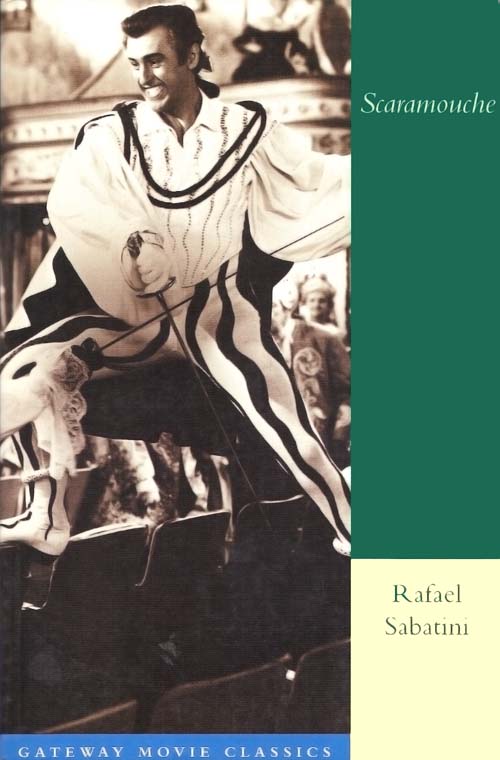
I ran right out and got a copy of Sabitini’s marvelous 400-page novel, Scaramouche.
Whoa, Sabatini.
-
Rafael
First off, I happen to think this is one of the most beautiful names ever. If I hadn’t already had a name ready for my son twenty years before he was born, I’d have named him Rafael. I did put a Rafael into a story once—a charismatic and lovable rascal—but it’s not finished yet. He’s still busy being charismatic and lovably rascally.
-
Historical setting
Just like Davisson Post, Sabitini was master of his era. However, unlike Davisson Post, Sabitini didn’t live through the historical times or anywhere near the times he portrayed in this novel. He apparently grew up in Italy and England at the end of the nineteenth century—raised by opera singers—and spoke six languages.
The setting of Scaramouche is late eighteenth-century France. . .that’s right: the French Revolution.
This is the world of Victor Hugo and Les Miserables. However, Sabitini makes it entirely his own through the fabulous attention to authentic detail and the excruciating moral rack upon which he puts his protagonist, the lawyer and aristocrat Andre-Louis. I learned more about the French Revolution from following Andre-Louis’ adventures through the tangled underground of proletariat revolt (aided, according to Sabitini, by the king himself against the aristocracy) than I ever got out of a history book.
Granted, Marie Antoinette gets a decidedly bum rap from Sabitini, as she has gotten through the history books as well, although there is now some question about exactly how dastardly she was and, contrariwise, how easy it was to scapegoat her for being a foreigner during a time in which the French were already doing quite well destroying their own proletariat without any help from outsiders at all.
But it doesn’t matter.
Because Scaramouche is a rollicking, rolling, high-quality literary tale of hair-raising adventure through one of the most significant and world-changing events of recent centuries.
And nobody’s ever going to agree about Marie Antoinette anyway.
-
Theatrical players
And this I love so much, because Andre-Louis acquires his nickname Scaramouche when he joins a troupe of traveling theatrical players and takes on the role of the archetypical ‘little skirmisher,’ as explained by the theatrical director: with “the gift of sly intrigue, an art of setting folk by the ears, combined with an impudent aggressiveness upon occasion when he considers himself safe from reprisals.”
Do you recognize this archetype?
I do.
The Native Americans called him Coyote, the Trickster. The Scandanavians called him Loki. The ancient Greeks called him Eros. Even during the Middle Ages, medieval courts always came equipped with their jester, the quintessential Fool of Shakespeare’s King Lear.
Now whenever I find myself frustrated by those who seem interested only in disrupting the joyous-but-serious work that we do here in the writing community, those who would throw cold water on our efforts to help craftspeople develop literary craft, who seemingly-deliberately take our sense of humor for insulting challenge and hard-won advice for penny-ante poker. . .I remind myself:
Life is a very mysterious place.
The gods may simply be messing with us.
Scaramouche, Scaramouche, can you do the fandango?
-
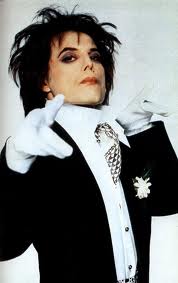 Freddie Mercury
And of course I couldn’t get through this without mentioning him.
If there was ever a Scaramouche for our poor and benighted, dark and dour, painfully-cynical and utterly-confused age, it was the exuberant queen of Queen.
The other night, my husband and I sang the entire “Bohemian Rhapsody” at the top of our lungs (okay, at the top of my lungs) while cooking dinner for our son, who said sweetly when we were finished, “I would have suggested we just play the record, but you seemed to be having so much fun.”
Must we forever be tilting at windmills, Freddie—our lives un-spared of monstrosities, trapped between Beelzebub and getting our lips to our baby, just got to get out, just got to get right out of here. . .blown any way the wind blows?
Yes. We must. They must.
And then we must create art about it.
1 thought on “4 Reasons to Love Rafael Sabitini & Freddie Mercury”
Comments are closed.