
In case you didn’t see last week’s post, I’ve been trying to interview Roz Morris, aka @dirtywhitecandy.
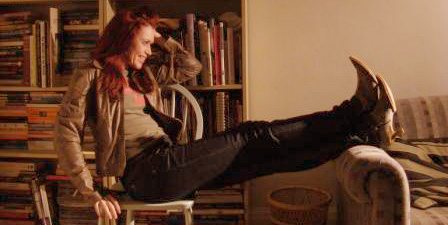 She’s the author of eleven ghostwritten novels, eight of them best sellers, owner of Nail Your Novel fiction-writing blog and author of her own self-published book on fiction techniques, Nail Your Novel.
She invited me to a wrestling match, threw me and then admitted she’s scared the occasional kickboxing teacher.
And she won the last round.
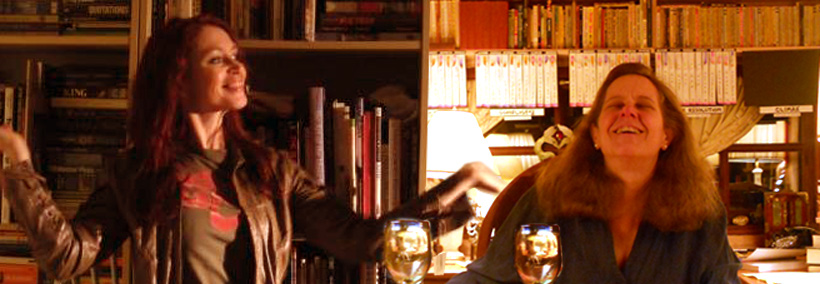
Welcome to Part II of eavesdropping on critiquer and independent editor Roz and Victoria. . .with wine:
V: Welcome back, Roz! I’ve been quite busy making up stuff about you for the interview in case your life is more boring than I think it needs to be.
Roz: Unusual things about me? Um. . .can’t think of any. Ah, no, this might do: I once got hit by a train—
V: A train?
Roz: Yes. I’ve got a little scar. I was actually hit by a train door, and it got a bit melodramatic. Some schoolboys opened it as the train was arriving, it swiped me on the forehead, and I bled all over the platform. People started screaming. An ambulance turned up, in dread of what they would see. Instead of a squished body on the track they saw me with a pad on my head, dripping blood and having a voluble argument with a fat station guard, who wanted me to tell him it was my fault. After stitches and advice on concussion (which I forgot the moment they told me), I was able to call work and say I’d been hit by a train but would be in the next day.
V: You forgot the moment they told you! Good grief. That is a concussion. No wonder you forgot to stay home from work. What were we just talking about?
Roz: Research.
V: Oh, yes. Tell me about the greatest lengths you’ve ever gone to for the sake of a book.
Roz: I’ve done some odd things in the name of research. I was interested in people who have themselves frozen in order to be brought back to life, so I looked up the English chapter of Alcor and went to visit them. I took some friends, and we pretended we were interested in having our corpses frozen. I snooped around their operating theatre, asking all sorts of cheeky questions. I met their other members, who together formed a character dynamic that was crying out to be written about.
I sat in on a meeting and made sure I was at the main desk, where I found all their recent mail—so I started to read it all. Amazingly, they didn’t stop me. There were letters from people wanting to do work experience, obviously not suspecting that they were asking for work experience in preparing corpses to be revived. Great afternoon. I haven’t written the novel yet, but it’ll be used in some way or other.
What’s the oddest thing you’ve done in the name of research? I know you mention writing fiction—do you still do that, is it on the back burner?
V: Yes, I’m still writing fiction. I’ve started a mystery about an independent editor. I made a bunch of outlines with white scenes on black construction paper over the holiday and taped them up over my desk. I have corkboard on the wall with tons of notes stuck to it. My son just stands in front of it all and muses.
As far as research? Chriminey, my whole life has been research. I’ve traveled a lot. The oddest research I ever did was probably the stuff I did against my will, which was drive around South America and Europe with my family for several years when I was a kid. That’s not the kind of research you ever get over. Someday I will write my memoir of it, and it will be poignant and significant and heartbreaking. But not today.
Roz: I want to read that book!
V: You know, my mother actually just sent me a whole album of photos I hadn’t seen in thirty-five years, along with her journal of that trip, which I had never seen at all. Talk about material.
Let’s chat about the format you work in. Most of my work is on-going over a period of weeks or even months. But you work for a place that commissions single critiques, is that right? And you’ve done reader reports for publishers and agents?
Roz: Most of my editing work is one-off critiques. Some is for private clients, some for the critiquing agency. Do you want to hear a bit of boasting?
V: Of course.
Roz: My first client became a New York Times bestseller after following my advice on his manuscript. My most recent client just got his MG novel in a bidding war and is now getting foreign deals.
My critiques often become reader reports because clients often submit them with manuscripts—but some industry people feel you shouldn’t do that. I copy edit and proofread for publishers too—which is necessary but not terribly creative. If we talk about that for five minutes it gives everyone time to go out and refresh their glass. . .
V: . . .(Talk talk.) We’re back!
Roz: I also do a lot of work that wanders over the border between editing and ghosting. I’ve rewritten manuscripts that have great content but whose authors were non-English speakers, or dyslexic, in too much of a hurry to write their own books properly—or whose editors have thrown up their hands in despair. I find that perversely fun—to take wordy murk and fillet out the interesting stuff. And then of course there’s the true ghosting, where I write the book from scratch. I’m not allowed to tell you who I’ve done that for. Not just because of contractual obligations, but because some of them are trained assassins and I don’t look good in a bullet-proof vest.
V: Swear to god, I’ve never even seen myself in a bullet-proof vest. Your life is way more interesting than I thought it was.
How do you get your jobs? Did you stumble into a gofer position at a publishing house at a tender age and just work your way up? Or do you know all the London literati and have cocktails with them every weekend? (And will you invite me if I ever turn up at Heathrow?)
Roz: I get most of my work through contacts, although I quite often send CVs to people and tell them I want to work for them. Seven times out of ten they probably bin me, but it’s how I got the work with the critiquing agency—and that worked out very well.
My first published book happened because my husband was commissioned to write a novel for a series, and when he delivered it the editors changed the brief. He couldn’t rewrite it because he had other projects, but I’d been dabbling with writing for years so he told the publisher that I would write the replacement. They had no other option, so they agreed. I gulped, got my head down and wrote. Six weeks later they accepted the manuscript—and I realised I was going to get away with it. After that initial back-door break, it slowly built up.
And if you ever turn up at Heathrow and don’t call me I will never forgive you.
V: My husband and I just had our annual winter conversation about a vacation in Europe. One of these years we’re simply going to pick up and go, so keep your brollie handy.
How much can a writer make for ghostwriting a book?
Roz: It all depends on the deal. It really helps to have an agent fighting your corner, to get a proper share of royalties and other rights. You can earn a lot because the books will be properly marketed—otherwise the editors wouldn’t be able to justify hiring a ghost as well as paying the ‘author’ whose name is on the cover.
But there are also unscrupulous companies who lure a writer into a ghosting job, pay them a flat fee, ask for unreasonable numbers of rewrites and don’t pay a royalty at the end of it. Or the terms and conditions mean that the writer doesn’t get royalties on sales that aren’t full price, such as book clubs and foreign deals.
Even worse, some unwary souls are conned into writing a book ‘for a share of the back end’. I did that once, got nothing and never did it again.
V: Warning heeded. Have you ghostwritten mostly fiction or nonfiction?
Roz: I’ve mostly ghosted fiction, but I’ve done one memoir as well. That wasn’t any particular plan—just the luck of the draw.
V: Are you still writing those ghost-novels? (I think I just broke the English language.)
Roz: Not at the moment, but there’s something in the pipeline. Right now, though, I’m pinning down my own WIP on the wrestling mat.
V: How’s that going?
Roz: More ups and downs than a bride’s nightie.
V: [laughing] Roz.
Roz: It’s been tough finding the strongest way to tell the story—I had to invent several new revision tools to get it right.
Now I’m on the detailed edit, which is ruthless in the extreme. I’m lopping out passages that are perfectly good but are holding back the pace. The outtakes file is three times as long as the actual text. Yesterday I congratulated myself on a joke that was dripping with several shades of irony—and today I hacked it out because it gave slightly the wrong tone for the scene it was in. You can tell I get a bit obsessive, can’t you?
V: This the the writing life, folks.
Roz: And, most difficult, I’ve based one of the characters on a longtime friend and this week had terrible news about him. All books put you through the mill, but that’s a bit impolite of fate, really—especially when I’m trying to concentrate on a book. But he’s got a bit better, so maybe we can cautiously raise a glass. (Ahem. Stop hogging the vino, Mixon. . .)
V: Oh! Excuse me. Say when.
So what’s the one thing you’d like to say to aspiring writers about this work we do—both the writing and the editing? What’s your editorial secret?
Roz: My secret? Oh, that question wasn’t for me.
V: Well, it was. I already know my own secrets. I think.
Roz: Ah! I started to reply, then figured it might be a tail-end question for the blog readers to encourage them to chat in the comments.
V: I never do that. I figure if they feel like contributing to the mayhem they know they’re welcome to, and if they’re shy they don’t want me making an issue out of it. I just have faith in their grasp on the general protocol.
Does this mean we’re done talking about fiction? Shall we break out the bubbly? Here. Let me peel you a grape. . .
Roz: Toodle-pip!
 Roz Morris, aka @dirtywhitecandy, will give you creative aneurysms. You should probably talk to her about that. She can be found at her blog, on Facebook, and on Twitter.
Please join us for more editorial conversation with Roz and Victoria in our four-part series: We can’t leave fiction alone—Talking Fiction.
TOP 10 BLOGGERS FOR WRITERS—GUEST POSTING:
Later this week I’m trading guest posts with K.M. Weiland of Wordplay.
I’ve enjoyed the series of interviews and learning more about Roz. 🙂 Thanks for hosting her, Victoria!
You’re welcome, Elizabeth! Isn’t she fun? I’m just this close to hopping on a plane to London.
Aw you GUYS! Thanks, Elizabeth – great to hear your interview the other week at Joanna Penn’s.
And Victoria is unique. She comes into dreams via the email inbox and talks in a broad Scottish accent.
Love these. I follow young Roz on twitter. Great blog, too.
I’m freakin’ DYING to know who she’s ghosted for now…
Shhhh…. not allowed to tell…
Clever marketing technique. I’ll be buying any and every SAS/assassin book out there, thinking it just MIGHT be the one you wrote.
My only observation is that it looks like you two are having way too much fun for the end of January! Just kidding … I enjoyed this version of Roz the awesome writer … and am pleased to meet you, Victoria! Cheers.
Hi Daisy! Certainly was a fun way to greet the new year. Victoria is a hoot. Hope your creative endeavours are going well.
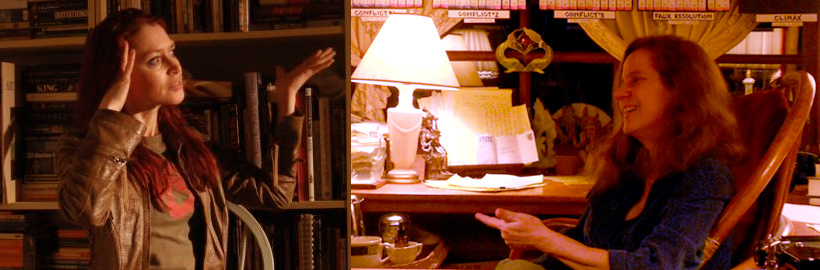
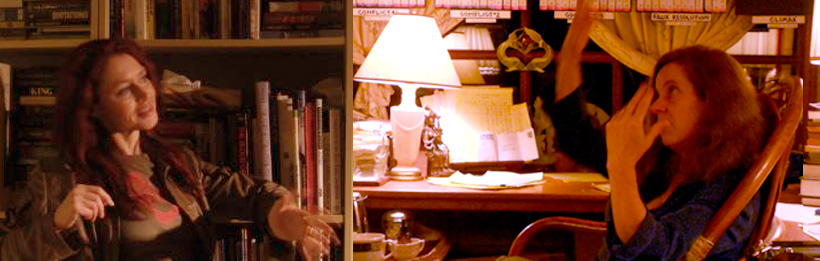
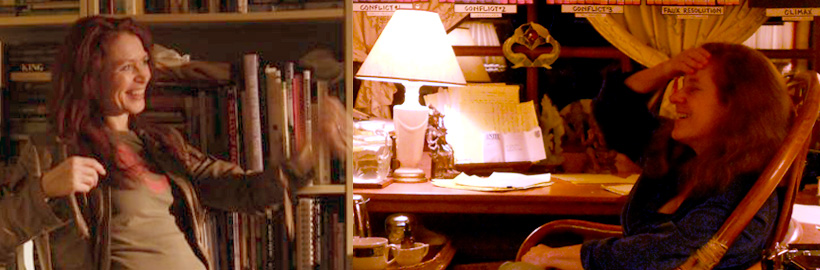
What a great interview. Love the photos interspersed to keep the “feel” of your casual exchange with interestingly full surroundings.
I appreciate this candid peek into your lives. Thanks for being two vital and vibrant people who are willing to share their insights with this wannabe. Actually, I’d love to hear your comments on Ghostwriting…how is it NOT cheating? How can the author lay claim to something he or she have not actually written? Isn’t that illegal in most other aspects of life?
I’ve been dying to ask someone that question! 😀
Amy, thorny question about ghostwriting. Readers think of it as cheating, as they buy the book because of the name on the cover. The big publishers, where this happens, don’t think of it as cheating at all because it’s been an accepted part of the industry for decades. It’s a way to produce books that people want to buy in large numbers – which is all they are interested in.
In most other aspects of life it would be regarded as cheating, yes. But this kind of cheating is all over the place. Politicians have speech-writers to make them look good. Singers might have electronic wizardry or even voice-doubles to beef up their weedy efforts.
It all comes down to this: an author’s name is a brand. And that brand isn’t always what it appears to be. Writers use names that aren’t their own. Ruth Rendall and Barbara Vine are one person, although it’s no secret. Currer, Ellis and Acton Bell thought they stood more of a chance getting published than if they used their real names of Charlotte, Emily and Anne. The fact that they did this suggested it mattered to readers at the time.
Sorry, that’s probably more of a philosophical view than a proper answer. The only answer I can offer is, that’s how the money end of a creative industry works. And there’s a bright side – the sales that those authors get will hopefully help fund those of us who are not so much a part of the commercial treadmill and give us a chance to win readers by our honest efforts.
But at least if there is cheating involved, I’m on the right side!
Roz and Victoria, I’ve been so looking forward to part 2 of this (I even opened the bottle days ago in anticipation!) and am now wishing for a part three. Thank you for sharing this wonderful dialog–cheers to you both!
(Cups her hands to her mouth and yells…) Victoria, she wants part 3! Can our husbands cope with more Photoshop?
Cheers, Erika!
We could probably keep talking indefinitely. Maybe we should start a series. We could post conversations on different topics: character, plot, prose. With jokes & wine.
If we started with a plan for a series of four, we could re-use the four shots from this post.
Huh. That’s actually kind of a good idea. I ought to try thinking first thing in the morning more often.
That’s a great idea. Or maybe an Easter special? With cabaret of course…
Yes, I am interested in how ghostwriting plays out. I have been asked to be a ghostwriter for a friend (memoir). Who is the author in this case ?? Do you pick an anonymous name, but in that instance, wouldn’t you be legally liable since the name may actually belong to a living or dead human you are unaware of ??
Or, would the author be my friend whose memoir I’ll be writing ??
Marjory, how exciting. If you’ve got your eye on publication, publishers usually prefer memoirs to be written by the actual subject – because readers prefer the personal contact. Writing it from ‘outside’ adds a barrier – they want the contact with the person who had the experiences.
You could write it as the close friend of the subject, in which case I’d advise making it as much about your relationship with the friend as about what happened to them. I just finished reading Richard Frere’s book about his friendship with the writer Gavin Maxwell, which does this very well. But Gavin Maxwell was famous and it was his name that really sold the book.
Good question about names. When picking pseudonyms, no one worries too much about searching through birth and death records for names that have never been used before! It’s impossible. Just avoid picking one that might be confused with a famous person now.
Without knowing what your friend’s story is, it’s hard to advise. But you need to keep the personal connection between them and the reader as much as possible, as first-hand experience is what readers want. Perhaps a pseudonym that would join the two of you?
As to who is the author…. in publishing contracts it’s the name on the cover.
Delightful foray into getting inside Roz’s head. Although I’m betting we’ve barely seen the tip of the iceberg. (Hugs)Indigo
Hugs to you too, Indigo!
“I had to invent several new revision tools to get it right.”
Can we please talk a lot more about this??? 🙂
Ah Linda, my blog is choc-full of revision tools. It’s easiest if you get the full versions –
Try this: http://nailyournovel.wordpress.com/2010/08/28/revising-my-novel-baby-steps-help-me-take-giant-strides/
And this, one of the tools in my book Nail Your Novel –
http://nailyournovel.wordpress.com/2010/03/29/the-beat-sheet-step-by-step-%E2%80%93-starring-harry-potter/
Have fun!
I have your book and love it… I just gave it a positive review on Goodreads. But you know, it’s like a potato chip. Sometimes you want to eat the whole bag. I just wanted to hear more about new revision tools! I’m pretty good at writing rotten first drafts. It’s the revision part that hurts…
Thanks so much for the review, Linda!
As for the revision tools… a lot of people have asked for more. I have another book in mind to help. Meanwhile, I’m finishing the book that has caused me to invent so many!
Exceptionl information, We viewing back again looking fur up-grades.
Y’all are using that comma wrong. FYI.
What, no penis enlargements? Or did my revision sword frighten you away?
Ladies, ladies…when are we all getting together for cocktails? The conversation would be delightful. Sparkling, even. Like champagne, or emo vampires.
I promise I’m even less appropriate in real life than I am online, if that helps any.
I did so enjoy this two-part interview. Thanks for this!
So let’s get happy hour penciled in on the ol’ schedule, shall we?
Any time, good sir.
hic!
What a fun interview! Thanks.